
EAAF — a vendor-neutral framework for building AI systems that are trustworthy, governable, extensible, and enterprise-ready. It’s the shape of a system you can defend to your board — not a product, and not anyone’s specific implementation.
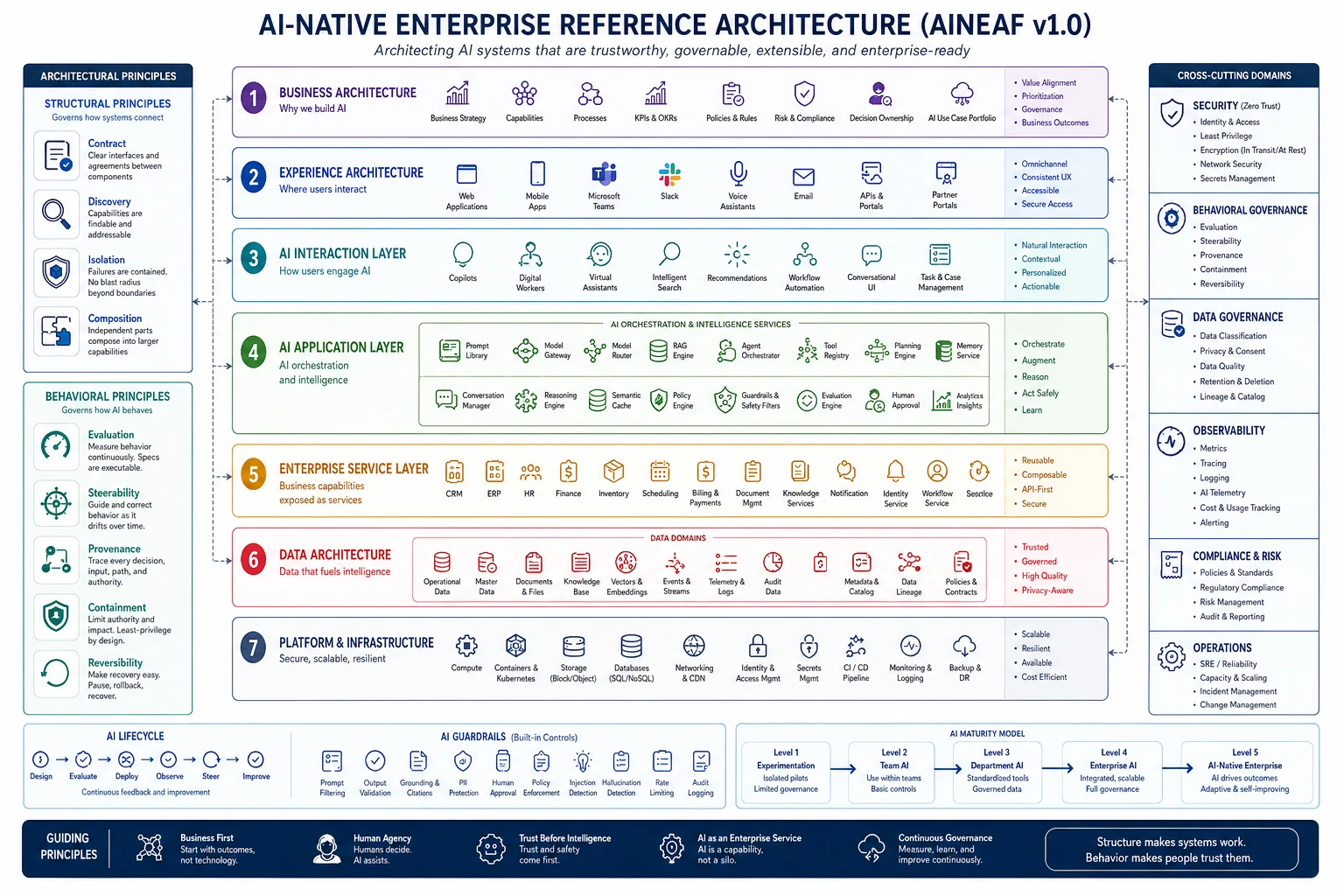
Click the diagram to open it full size.
EAAF organizes an AI-native enterprise from business intent at the top to infrastructure at the base, with trust enforced across every layer rather than bolted on at the end. The point is sequencing and separation of concerns — and making the controls that keep AI safe a property of the architecture, not an afterthought.
Structural principles — Contract, Discovery, Isolation, Composition. The load-bearing structure of any extensible platform; they govern how components connect safely and have held for more than two decades. More on this →
Behavioral principles — Evaluation, Steerability, Provenance, Containment, Reversibility. What governs AI behavior once it stops being deterministic — how you measure it, steer it, explain it, bound its authority, and recover when it’s wrong. More on this →
Applied across every layer, not parked in one: Security (zero-trust, least privilege, secrets), Behavioral Governance (evaluation, steerability, provenance, reversibility), Data Governance (classification, consent, quality, residency), Observability (metrics, tracing, drift), Compliance & Risk (policy, audit, reporting), and Operations (SRE, reliability, cost, change). Data protection → · Trusting AI agents →
Guardrails are built in — prompt and output filtering, deterministic validation, injection screening, PII redaction, rate limiting, and audit logging. The framework runs on an AI lifecycle (Design → Evaluate → Deploy → Observe → Steer → Improve) and a five-level maturity model from isolated experimentation to AI-native operations. Five guiding principles hold it together: Business first · Human agency · Trust before intelligence · AI as an enterprise service · Continuous governance.
Every real enterprise diverges from this framework — and knowing where to diverge, and why, is the engagement. The map is free; the judgment to adapt it to your data, risk profile, and constraints is the work.
I design and build exactly this — tailored to your data, risk, and constraints. Get in touch.