Illustrative scenarios

From pilot to production — what the work looks like.

Five recurring problems I solve, and — just as importantly — the controls that make each one safe to put into production. Trust isn’t a slide at the end; it’s built into every solution.

These are illustrative scenarios — representative of the problems I solve and how I build trust into each, based on patterns common across enterprise AI programs. They’re written in the first person to show my approach; they are not accounts of specific client engagements, and any figures are typical ranges.

AI Governance & Trust · AI Application

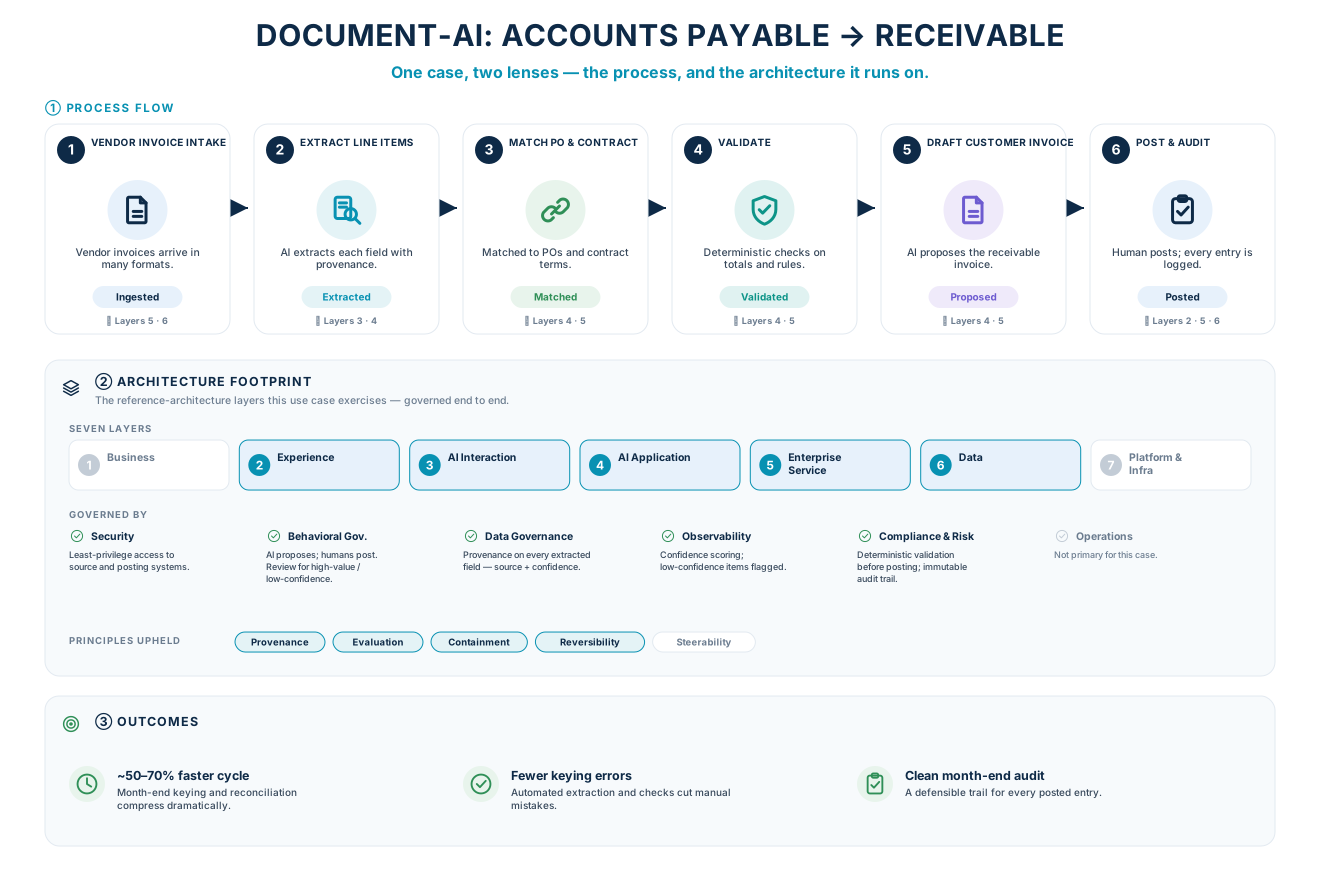
Document-AI accounts payable → receivable

Challenge

Finance keyed vendor invoices by hand, reconciled them against purchase orders and contracts, then manually produced customer invoices — slow, error-prone, and hard to audit at month-end.

Approach

An agentic intake pipeline extracts line items from vendor invoices, matches them to POs and contract terms, and drafts the corresponding customer invoices — with the AI proposing values, never finalizing them.

Controls that made it safe

  • Deterministic validation (format, PO existence, totals, contract rules) before any posting
  • Provenance on every extracted field — source document and confidence
  • Human review for high-value or low-confidence items
  • Immutable audit trail of every posted entry

Outcome

~50–70% faster cycle Fewer keying errors Clean month-end audit
Agentic & RAG Platforms

Intelligent workflow automation

Challenge

A core operational workflow spanned several systems and required staff to copy data between them, chase approvals, and handle exceptions by hand — capacity-limited and inconsistent.

Approach

I mapped the end-to-end workflow and introduced agents to handle the routine path — reading inputs, updating records, routing approvals — while exceptions escalate to a human queue.

Controls that made it safe

  • Risk-tiered automation: routine auto-handled, consequential steps gated
  • Every action scoped to verified identity and least privilege
  • Reversibility — any step can be paused and rolled back
  • Full decision log for traceability

Outcome

~60% handled hands-free Faster turnaround Staff freed for judgment work
Agentic & RAG Platforms

Automated service provisioning & onboarding

Challenge

Onboarding a new customer or service meant coordinating setup across CRM, billing, and operational systems — days of manual steps, with frequent rework when something was misconfigured.

Approach

I orchestrated provisioning as a guided, mostly-automated flow: agents assemble the configuration, validate it against business rules, and activate across systems once every check passes.

Controls that made it safe

  • Validation gate before activation — no half-provisioned states
  • Tenant-scoped data access throughout
  • Human approval for non-standard configurations
  • Audit trail from request to activation

Outcome

Days → hours Fewer misconfigurations Repeatable onboarding
AI Governance & Trust

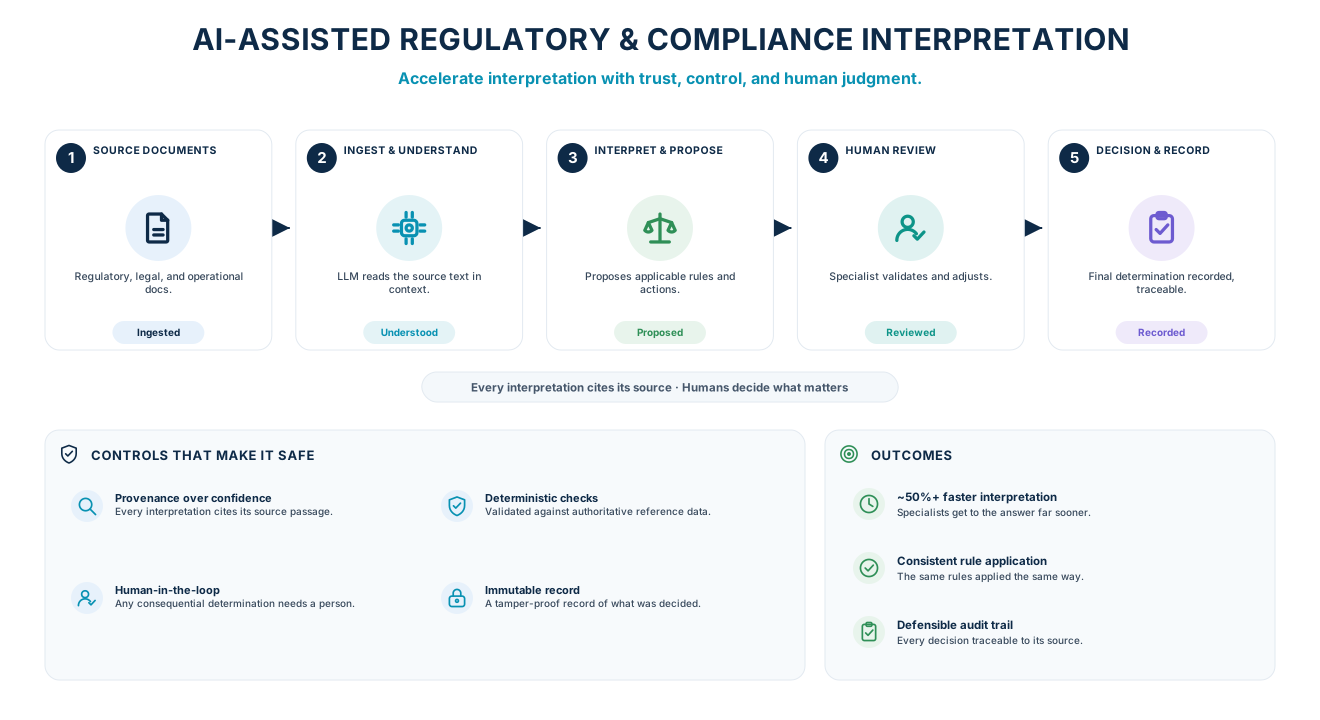
Regulatory & compliance document interpretation

Challenge

Specialists spent hours reading dense regulatory, and operational documents to determine what applied and what action to take — a bottleneck where mistakes carry real compliance risk.

Approach

An LLM-assisted layer interprets the source text and proposes the applicable rules and required actions, surfaced to specialists with citations — accelerating interpretation without removing human judgment.

Controls that made it safe

  • Provenance over confidence — every interpretation cites its source passage
  • Deterministic checks against authoritative reference data
  • Human-in-the-loop for any consequential determination
  • Immutable record of what was interpreted and decided

Outcome

~50%+ faster interpretation Consistent rule application Defensible audit trail
AI-Augmented SDLC

Legacy modernization, accelerated by AI-augmented SDLC

Challenge

A legacy estate — monolithic, hard to change, expensive to run — needed to become cloud-native and AI-ready, but a multi-year rewrite is risky and slow with traditional methods.

Approach

A pragmatic, phased migration to cloud-native microservices, accelerated with AI-assisted development and quality gates — keeping the legacy system stable in a transition-state architecture while new modules ship.

Controls that made it safe

  • Quality gates (tests, scans) on every AI-assisted change
  • Strangler-fig transition — legacy stays stable while functionality moves
  • Observability and rollback at each cutover
  • Measurable coverage and defect tracking

Outcome

Faster delivery Higher test coverage New modules shipped mid-transition
Let's talk

Recognize something familiar?

If any of this resonates, I’m always glad to compare notes — reach out any time.