
Trusting AI Agents Without Getting Burned: A Leader's Briefing on Data Quality
An executive perspective on what changes when AI agents generate operational data — and what organizations must put in place before mistakes become expensive.
AI agents are no longer experimental. Organizations are handing them real operational work: reading unstructured inputs, extracting information, updating records, initiating workflows, making recommendations. The productivity upside is real. But beneath the excitement lies a quieter shift that deserves leadership attention.
When traditional software writes data into enterprise systems, correctness is largely deterministic — the same input produces the same result. AI agents change that assumption. An agent that extracts the correct value today may produce a subtly incorrect one tomorrow, while sounding equally confident both times. The failure is often silent: incorrect outputs look indistinguishable from correct ones until they surface downstream as financial discrepancies, compliance issues, or poor decisions. This is not an argument against AI agents. It’s an argument for building the right controls around them.
The core principle
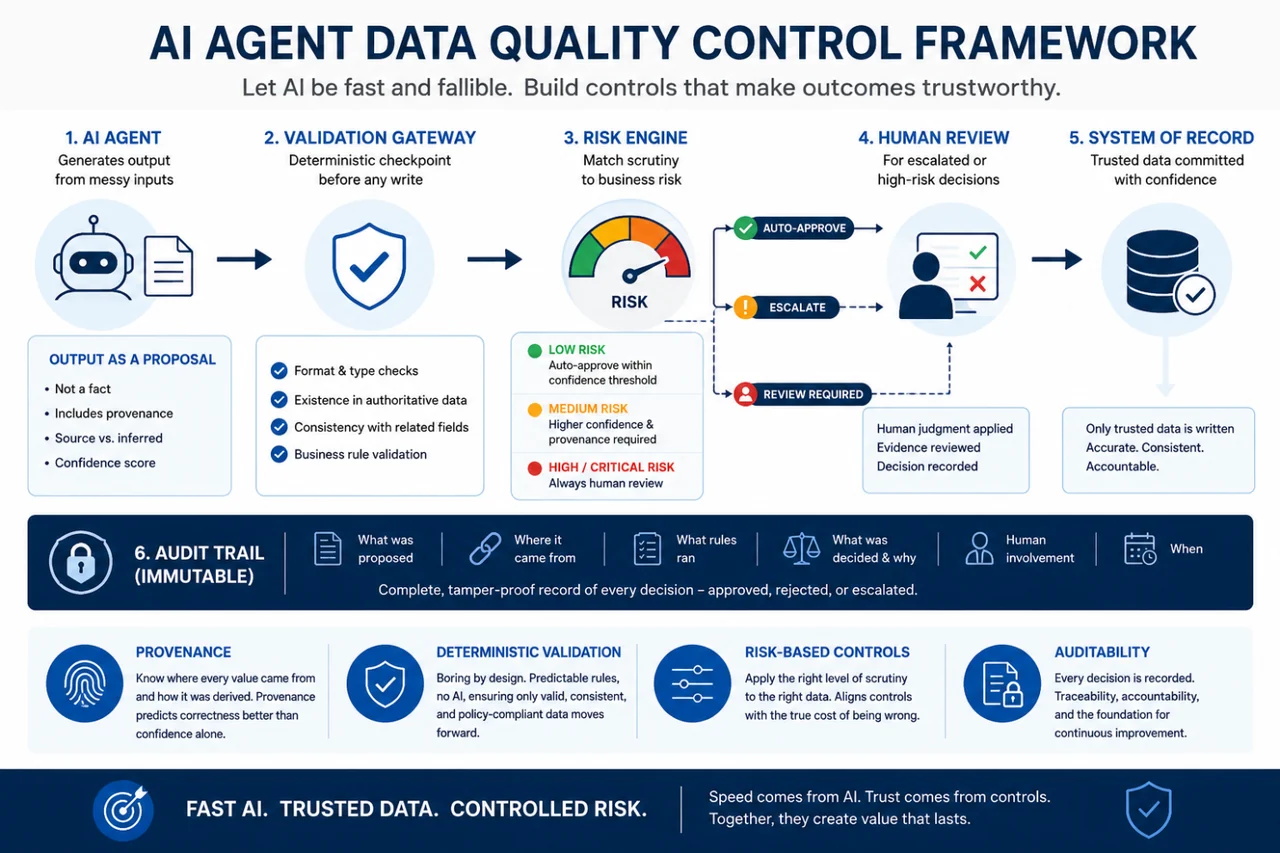
Let AI be fast and probabilistic — but surround it with deterministic, auditable, risk-aware controls that decide what can be trusted. AI agents are excellent at fuzzy, context-heavy tasks. They should not be the final authority on what enters systems of record. Organizations need a governance layer that determines what can be trusted automatically, what requires additional validation, what should be escalated to a human, and how every decision is recorded. AI alone is insufficient. Rigid rules alone are insufficient. The value emerges when both work together.
What good looks like
High-performing organizations typically implement four foundational controls.
1. Treat agent output as a proposal — not a fact
Every AI-generated value should arrive with context about how it was derived. Did the agent directly extract it from a trusted source, or infer it through reasoning? This distinction — data provenance — often predicts correctness better than the model’s confidence score. Confidence tells you how certain the model feels; provenance tells you why the answer exists in the first place.
2. Place a deterministic checkpoint before every write
No AI-generated output should move directly into a system of record. Between the agent and enterprise data sits a deterministic validation layer that asks predictable questions: Is the format valid? Does the value exist in authoritative systems? Is it internally consistent with related fields? Does it violate business rules? This layer should be intentionally boring — no additional AI, no probabilistic reasoning. You cannot reliably validate uncertain output using more uncertainty. Predictability is the feature.
3. Match scrutiny to business risk
Not all data deserves the same level of review. Classify data by cost of failure. Low-risk, recoverable fields can often be auto-approved within reasonable thresholds. High-impact operational fields should require stronger evidence and trusted provenance. Critical fields — anything with financial, legal, safety, contractual, or regulatory consequences — should always involve human oversight. This is not merely a technical decision; what you automate reflects your organization’s risk appetite.
4. Log every decision
Every approval, rejection, override, and escalation should be recorded in an immutable audit trail: what the agent proposed, where the data originated, which validation rules executed, why the outcome was approved or rejected, and whether a human intervened. This turns “the AI did something” into a transparent, accountable process.
Why auditability is the hidden ROI
Leaders sometimes view logging as overhead. In reality it’s where much of the long-term value sits: traceability (reconstruct exactly what happened instead of guessing), early-warning signals (rising error rates become visible before silent corruption spreads), and continuous improvement (every human correction becomes training data for governance — thresholds improve, validation rules mature). Over time, organizations stop guessing where guardrails belong and start learning from evidence.
What this architecture protects you from
Without these controls, failures follow a predictable pattern: small errors enter quietly, propagate, become dependencies; commitments get made, money moves, reports are generated; and eventually someone discovers something is wrong — often too late and without a clear explanation of how it happened. Trust erodes, and the productivity gains that justified AI adoption begin to disappear. With proper controls, mistakes are caught at the point of entry, high-risk decisions receive appropriate scrutiny, and the organization keeps confidence without sacrificing speed. AI stays fast. The business stays in control.
Three questions every executive should ask
You don’t need to be technical to govern AI-generated data effectively. Ask your teams:
- What happens between an AI agent’s output and a committed system update? If the answer is “we trust the model,” there’s likely a governance gap.
- Which decisions can an AI make independently — and which can it never make alone? If no one has documented this, the decision has already been made by default.
- If an AI-generated error surfaced today, could we explain exactly what happened and why? If not, auditability is missing.
The bottom line
Organizations rarely get burned by AI because the models failed. They get burned because they assumed intelligence alone was enough. Just as with people, trust in AI is built from experience — and it should grow with confidence, bounded by how much that experience justifies. The organizations succeeding with AI agents are solving a different problem: not “Can the AI do the work?” but “How do we know the result is trustworthy?” The architecture to answer that question already exists. It’s mature, practical, and increasingly it will separate organizations experimenting with AI from those successfully operating with it.