
AI Can Generate Data Mappings Faster. Governing Them Is the Harder Problem.
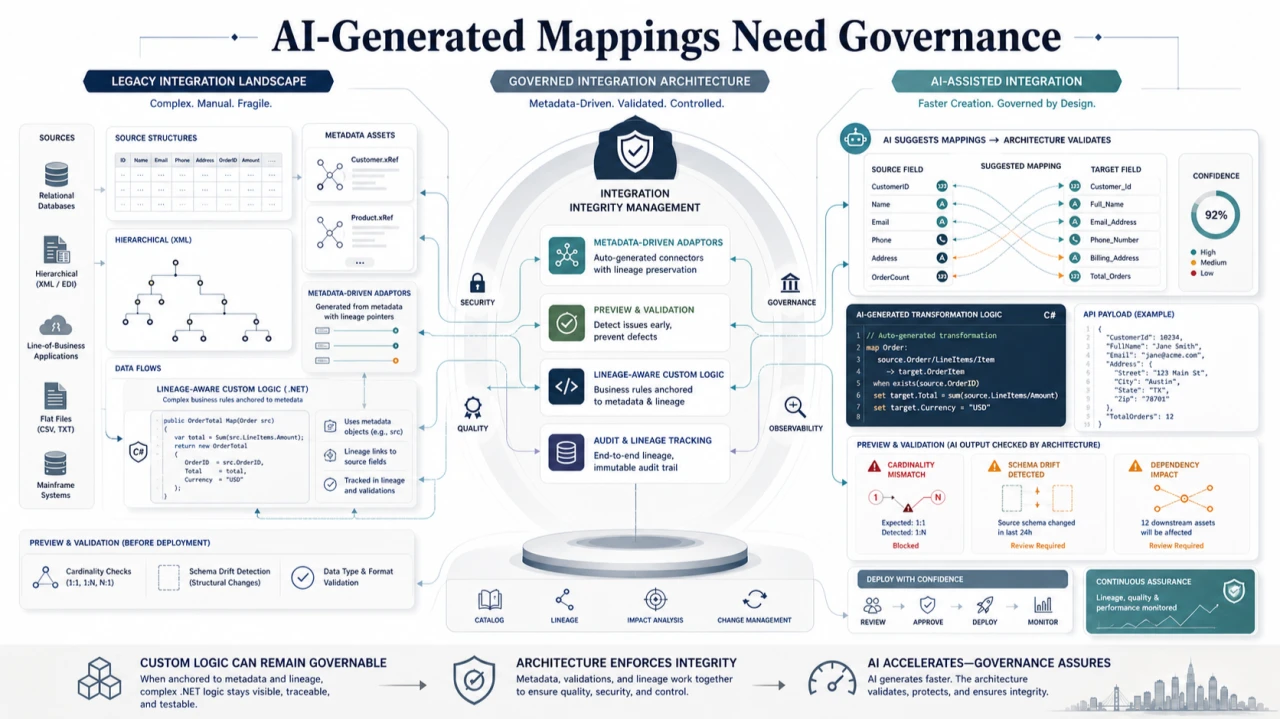
One of the biggest risks in enterprise AI is not that models fail to generate code. Models can now generate integration logic faster than organizations can validate, govern, version, and operate it safely.
A mapping can look correct, compile cleanly, and even pass limited tests, while still breaking lineage, violating downstream assumptions, or quietly corrupting data flows. That is why the real bottleneck in AI-assisted integration is no longer generation. It is architecture.
The lesson from Enterprise Enabler
I learned that lesson more than two decades ago when I architected Enterprise Enabler, an EAI and ETL product suite that included a sophisticated data mapping platform. The technologies were different, but the core problem was the same one we face today: how do you make integration logic powerful enough to handle enterprise complexity without making it opaque, fragile, or ungovernable?
Enterprise Enabler was built to handle messy integration reality: relational and hierarchical source systems, multiple line-of-business applications, and very different formats, assumptions, and dependencies across the enterprise.
It used metadata-driven adaptors to describe source and target structures, supported preview of data at the source, in transit, and at the destination, and allowed complex transformations when declarative mapping alone was not enough.
Why custom logic must stay anchored to metadata
That last part was important. We allowed developers to write custom .NET code for difficult edge cases. It was powerful, but what mattered architecturally was that the code did not exist in isolation. Complex business logic had pointers back to source metadata, which made lineage easier to track and kept custom transformations connected to the platform’s governance model.
That distinction matters. In many integration platforms, embedded procedural code becomes a blind spot: difficult to analyze, difficult to migrate, and disconnected from metadata. Our goal was to avoid that outcome by ensuring that even custom logic remained anchored to metadata and the surrounding integration framework. That feels especially relevant now. AI-generated code becomes far more useful and far less risky when it is tied to metadata contracts, lineage, validation, and controlled execution rather than introduced as free-floating logic.
Integration integrity has to be actively managed, not assumed
To counter erosion elsewhere in the integration lifecycle, we also built around the idea that integration integrity had to be actively managed, not assumed. That thinking led to patented work on integration integrity management: a system designed to detect change, including schema or endpoint drift, identify affected interfaces and applications, notify responsible parties, and coordinate safe implementation. That is precisely the kind of guardrail AI-enabled integration platforms need today.
Governed AI-assisted integration, not autonomous integration
This is why I do not believe the future is autonomous integration. I believe it is governed AI-assisted integration.
AI should help teams infer mappings, draft transformations, generate tests, flag anomalies, and accelerate adaptor development. But its outputs must compile into governed assets, not unmanaged prompts or hidden code fragments. They need metadata, preview, versioning, validation, dependency awareness, controlled rollout, and clear lineage back to the source structures they act upon.
Consider a concrete case: an AI proposes a mapping between a legacy order schema and a new fulfillment API. Before that mapping reaches production, the adaptor’s metadata contract should flag a cardinality mismatch: one order line being mapped to many fulfillment records. That is the kind of structural problem Enterprise Enabler’s runtime checks were designed to catch. The AI drafted the logic in seconds. The architecture is what keeps it safe.
The bottom line
The winners in this space will not be the platforms that generate mappings the fastest. They will be the ones that wrap AI generation inside rigorous enterprise architecture.
AI can accelerate integration work. But trust, control, and integrity are still architectural disciplines, not model features.