
The Enterprise Doesn’t Run on Code. It Runs on Meaning.
Three AI agents at the same company can read the same customer record and hand back three different, entirely defensible answers to who that customer is. Every one of them will pass its tests.
A sales agent flags the account “Preferred” because it crossed a revenue threshold last quarter. A billing agent doesn’t apply the Preferred discount, because in its training data that label always required a signed renewal, not just revenue. A support agent escalates the ticket anyway, inferring Preferred status from two years of response-time history nobody ever wrote down as a rule. Each agent is right, by its own evidence. None of them agrees with the other two. And nobody can point to a document that says which one the company actually meant. For twenty years before AI showed up, a person just knew.
That’s not a training problem, and it isn’t a bug anyone will find in a code review. It’s a gap that was always there, quietly closed by a person who never wrote the rule down. It’s exactly the kind of gap that’s been sitting underneath every generation of enterprise technology, waiting for something finally fast enough, and confident enough, to expose it.
Every generation of enterprise technology arrives with the same promise: this time, the old system finally gets replaced.
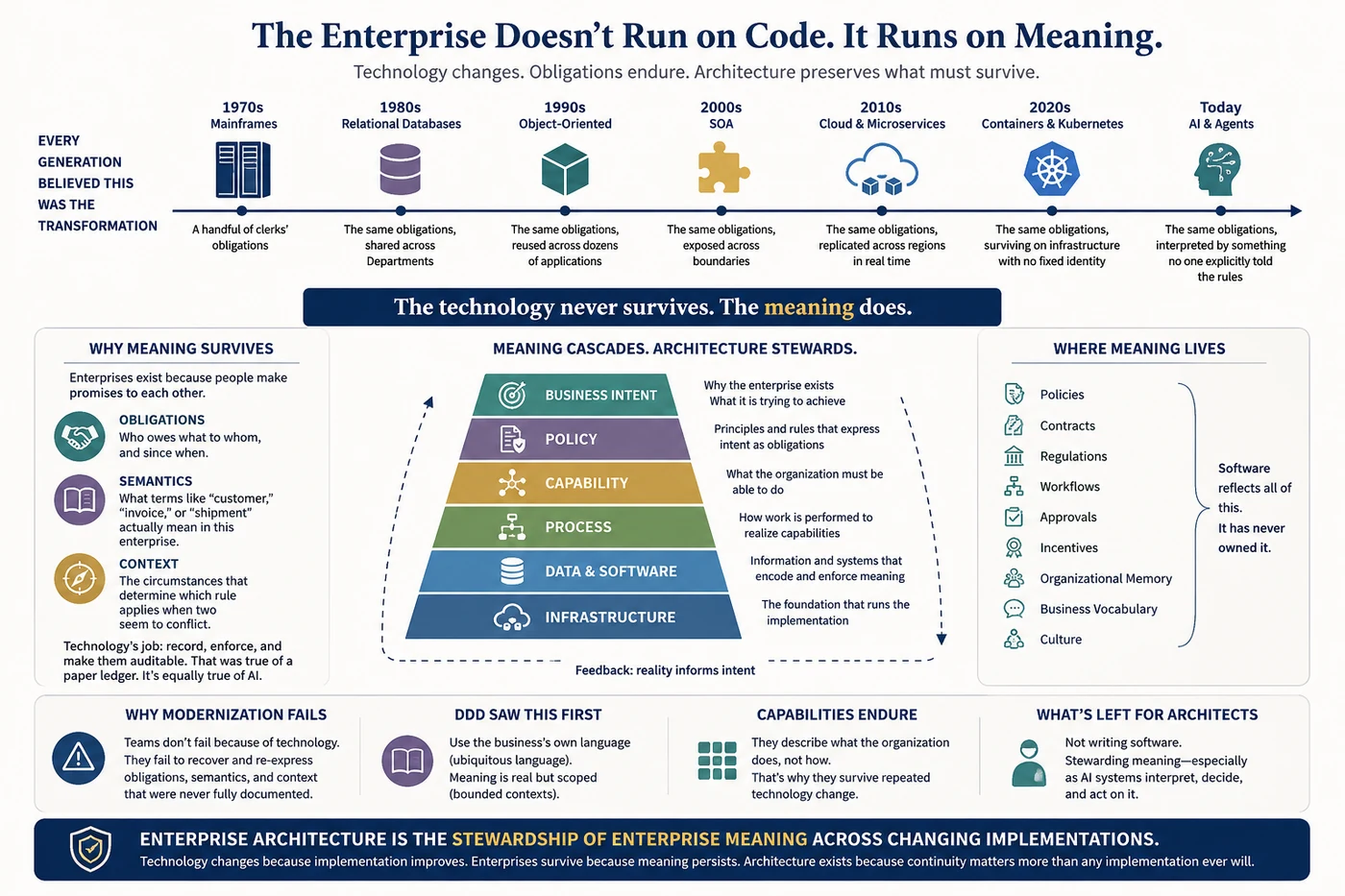
Mainframes were going to replace paper ledgers. Relational databases were going to replace mainframes. Object-oriented programming was going to replace procedural code. Service-oriented architecture was going to replace monoliths. The cloud and microservices were going to replace on-prem everything. Containers and Kubernetes were going to replace all of that again. And now AI and autonomous agents are promised as the technology that finally replaces the rest.
Look closely at each transition, though, and something else was actually happening underneath. The obligations never changed. What changed was how much strain the technology recording them had to survive.
| Era | Technology Changed | What the Technology Had to Keep Faithful |
|---|---|---|
| 1970s | Mainframes | A handful of clerks’ obligations, encoded in software for the first time |
| 1980s | Relational databases | The same obligations, now shared consistently across whole departments |
| 1990s | Object-oriented programming | The same obligations, reused across dozens of new applications at once |
| 2000s | SOA | The same obligations, exposed across organizational and system boundaries |
| 2010s | Cloud & microservices | The same obligations, replicated across regions and providers in real time |
| 2020s | Containers & Kubernetes | The same obligations, surviving on infrastructure with no fixed identity |
| Today | AI & agents | The same obligations, now interpreted by something no one explicitly told the rules |
Every generation believed technology was the transformation. Architecture quietly had a different job: preserve the enterprise while everything else, including the amount of strain the system was under, kept changing.
The technology never survives. The meaning does. An enterprise does not exist as software. It exists as meaning. Software is just the current implementation of it, and “current” is doing a lot of work in that sentence, since every implementation before this one also felt permanent while it lasted.
Why Meaning Survives at All
It’s tempting to treat “meaning outlives technology” as a nice observation and move on. But it has an actual mechanism, and naming it is what turns this from a metaphor into an argument.
An enterprise exists because people make promises to each other. Customers are promised a service. Employees are promised a wage. Governments are promised compliance. Suppliers are promised payment. Shareholders are promised a return. Every one of those relationships creates an obligation. Obligations don’t live inside software. They live between people and institutions, independent of whatever system happens to be recording them this decade.
That’s worth pinning down precisely, because the word “meaning” is about to carry a lot of weight in this piece, and it’s easy for an abstract word to blur across paragraphs. Enterprise meaning is three things, braided together:
- Obligations: who owes what to whom, and since when.
- Semantics: what a term like “customer,” “invoice,” or “shipment” actually refers to inside this enterprise, specifically.
- Context: the unwritten circumstances that decide which rule applies when two seem to conflict: a contract exception, a regulatory ruling, a convention nobody wrote down because everyone at the time just knew it.
Technology’s job has only ever been to record those three things, enforce them consistently, and make them auditable. That was true of a paper ledger, and it’s equally true of a mainframe tape, a relational database, or an AI agent. Meaning survives every technology generation because obligations, semantics, and context survive. They don’t get to retire just because the system tracking them does.
Someone has to keep track of all three, every time the technology recording them changes. For the last fifty years, that someone has had a name: the architect. Most of what follows in this piece is really about what that job has always actually been, and why it doesn’t change, even though almost everything about how software gets built is about to.
What an Enterprise Actually Is
A customer isn’t a row in a table. A customer is someone owed a service, someone with contractual rights, someone with privacy obligations, someone with a financial history that has to be honored correctly every single time. An invoice isn’t a JSON object. It’s a legal document, a tax obligation, a trigger for revenue recognition, a piece of audit evidence that might be scrutinized years later. A shipment isn’t an API call. It’s a transfer of ownership, a reduction in inventory, a promise kept to a customer, a regulatory event that has to be compliant in a dozen jurisdictions at once.
None of these are programming concepts. They’re obligations, semantics, and context wearing business names. Code is just the vehicle that carries them at a given point in time.
So where does this meaning actually live, if not in the software? Simultaneously in a lot of places software never fully touches: policies, contracts, regulations, workflows, approvals, incentives, organizational memory, business vocabulary, culture. Software reflects all of that. It has never owned it.
Here’s a way to test that claim.
Suppose every line of software at a company disappeared tomorrow morning. Would the enterprise disappear with it?
No.
People would still know who owes money, who owns the inventory, who’s allowed to approve a purchase, who reports to which regulator, who gets paid and how much. The enterprise would keep functioning, badly and slowly, on paper and phone calls. But it would keep functioning. Because the enterprise was never the software to begin with. Software is simply the fastest expression of it anyone has built so far.
COBOL wasn’t the business. Java wasn’t the business. Kubernetes isn’t the business. AI isn’t the business. The business exists independently of all of it. The whole job of architecture is making sure each new technology continues to express that same underlying meaning, faithfully, without quietly losing or distorting it along the way.
That’s also why meaning doesn’t sit in one place: it cascades. Business intent turns into policy, policy turns into capability, capability turns into process, process turns into data and software, software runs on infrastructure. Architecture’s job spans that entire stack: not defending any single layer, but making sure what the business actually means and intends survives translation all the way down to the hardware, and back up again every time the hardware changes.
Why Modernization Projects Actually Fail
Most organizations think of a modernization project as a technical migration: move the COBOL to Java, lift the on-prem system to the cloud, replace the monolith with services. But that framing is the reason so many of these projects go over budget, miss deadlines, or quietly break things nobody notices until months later. Teams migrating a 40-year-old system aren’t translating code. They’re trying to recover and re-express four decades of accumulated obligations, semantics, and context, much of which was never fully written down anywhere, including in the code itself.
This isn’t a hypothetical concern; it’s the exact fault line the industry is arguing over right now, with AI in the middle of it. In February 2026, IBM’s Rob Thomas published a piece bluntly titled “Lost in Translation: What the AI Code Debate Keeps Getting Wrong,” making a point that’s almost a direct echo of this argument: translating code and modernizing a platform are not the same thing, and the gap between the two is where most enterprises actually get into trouble. AI tools have gotten genuinely good at the discovery and translation phases: reading a legacy codebase, mapping its structure, even generating a first-pass rewrite. What they consistently struggle with is the business logic nobody documented: the exception someone hard-coded during a regulatory change fifteen years ago, the approval path that exists because of a lawsuit nobody remembers, the pricing rule that only fires for a single legacy client contract. That’s context, not code. It was never really “in the code” in a way that reading the code recovers it. It lived in the heads of the people who wrote it, and often left the organization along with them.
That’s the honest version of the claim, and it matters to state it that way rather than overreaching. It’s tempting to say “AI can’t understand the business,” but that’s not quite right, and vendors are actively pushing back on cruder versions of this argument. Large language models have gotten meaningfully better at recognizing patterns across millions of lines of legacy code and inferring the computational intent behind them. AI can absolutely help recover meaning that’s locked inside code nobody has looked at in twenty years. What it cannot do is originate authority over what a term should mean going forward, or adjudicate between two conflicting undocumented conventions when neither was ever written down as a rule. Someone still has to decide what “Preferred Customer” is supposed to mean at this company, why one legacy discount rule fires and a seemingly identical one doesn’t, which of two contradictory undocumented behaviors is actually correct. That decision is semantic and organizational, not computational, and no amount of code-reading capability changes who gets to make it.
Enterprise Meaning Existed Before Software Modeled It
This isn’t a new observation. Eric Evans made essentially the same argument in Domain-Driven Design over twenty years ago, though the book is often remembered as a pattern catalog rather than what it actually was: a case for building software in the business’s own vocabulary, a ubiquitous language, rather than a separate technical one that has to be translated back and forth every time engineering talks to the business.
One nuance is worth keeping, because it sharpens the point rather than softening it. Evans never claimed semantics are uniform across an entire enterprise. He built in the idea of a bounded context specifically because “customer” in billing and “customer” in support aren’t actually the same concept, and pretending otherwise is exactly the kind of ambiguity that breaks software. Meaning is real and business-owned, but it’s scoped to context, not universal, and architecture is what manages the seams between those contexts. DDD was never really about classes. It was about protecting meaning from technological distortion, context by context.
Business Capabilities Are Semantic Maps, Not Technology Diagrams
A business capability model deliberately describes what an organization does, not how it does it, and not what org chart or technology happens to implement it today. That’s precisely why it survives repeated technology change: when a bank replaces its entire core banking platform, the “Account Management” capability doesn’t blink. The technology underneath it changes completely. The capability, the meaning, persists exactly as it was.
Capability models endure for exactly the same reason DDD does: they describe semantics, not implementation. That’s the whole reason they survive.
What’s Actually Left for Architects, Now That AI Writes the Code
AI writes code. AI designs APIs. AI generates SQL and test suites. It’s not far-fetched to expect AI to eventually generate entire systems end to end. So what’s actually left for the architect promised a few sections ago, once the thing architects have historically been paid to produce (specifications, diagrams, code) can be generated in minutes?
Not writing software. Stewarding obligations, semantics, and context as the technology underneath them changes hands again.
Go back to the sales, billing, and support agents from the opening, each with its own defensible answer to what “Preferred Customer” means. No amount of better prompting or bigger models resolves that disagreement on its own, because it was never a modeling problem. AI cannot know what “Preferred Customer” truly means inside a specific enterprise, with its specific twenty years of exceptions. It cannot discover a contractual obligation that was never written into any system and exists only as an understanding between two people who left the company years ago. Nothing guarantees three independently-built agents converge on the same definition by themselves. That’s exactly how you end up with three technically correct, mutually contradictory answers to what should be one settled business fact. Those meanings belong to the enterprise, not to any implementation of it, including whichever AI model happens to be writing the code, or making the decision, this year.
This is also, not coincidentally, the exact identity crisis the enterprise architecture profession is currently having in public. A recent industry survey found that roughly a third of what EA teams produce is never reused by the rest of the organization, meaning much of the discipline’s traditional output, the diagrams and documentation, is being quietly ignored. That’s not a resourcing problem. It’s a sign that the version of EA built around being a documentation custodian doesn’t have much of a future, AI or not. The version of EA that survives is the one that owns and defends what the enterprise’s core concepts actually mean: who has the authority to define “customer,” “order,” or “approved,” and who arbitrates when two systems, or two AI agents, disagree. That’s what AI governance actually reduces to here: not controlling AI as a technology, but protecting semantics, making sure whatever AI produces still means what the business has always meant by that term, even as the thing producing it changes completely.
A Definition Worth Proposing
Most definitions of enterprise architecture are built around alignment, governance, standards, or technology fit. Those aren’t wrong, but they describe the activities, not the underlying purpose those activities serve. Here’s a narrower one, with a more active verb:
Enterprise architecture is the stewardship of enterprise meaning across changing implementations.
Discipline suggests rules. Stewardship is closer to what’s actually happening: an ongoing, active responsibility for something that isn’t yours to keep, only to protect on behalf of whoever comes next. It also explains governance without needing a separate theory of governance: stewardship of obligations, semantics, and context is what governance has always actually been, once the frameworks and committees built around it are stripped away.
The Pattern Repeats, Once More
Mainframes disappeared. CORBA disappeared. EJB disappeared. SOAP faded out. Containers will eventually be replaced by whatever comes next, and today’s AI frameworks will, in time, become someone else’s legacy system to modernize.
But look closer at what’s actually being preserved through all of that, and it isn’t meaning for its own sake. It’s continuity. Meaning is simply what makes continuity possible: the mechanism, not the goal. Every generation believes it is building the future. Every generation eventually becomes someone else’s legacy. What survives them all is the continuity of meaning the enterprise entrusted to architecture.
The enterprise doesn’t run on code. It never did. It runs on meaning.
If you’re in the middle of a modernization effort and want a second pair of eyes on where the real risk sits, in the migration plan or in the meaning nobody wrote down, happy to compare notes. Get in touch.