
Your AI Agent Remembers. That's the Problem.
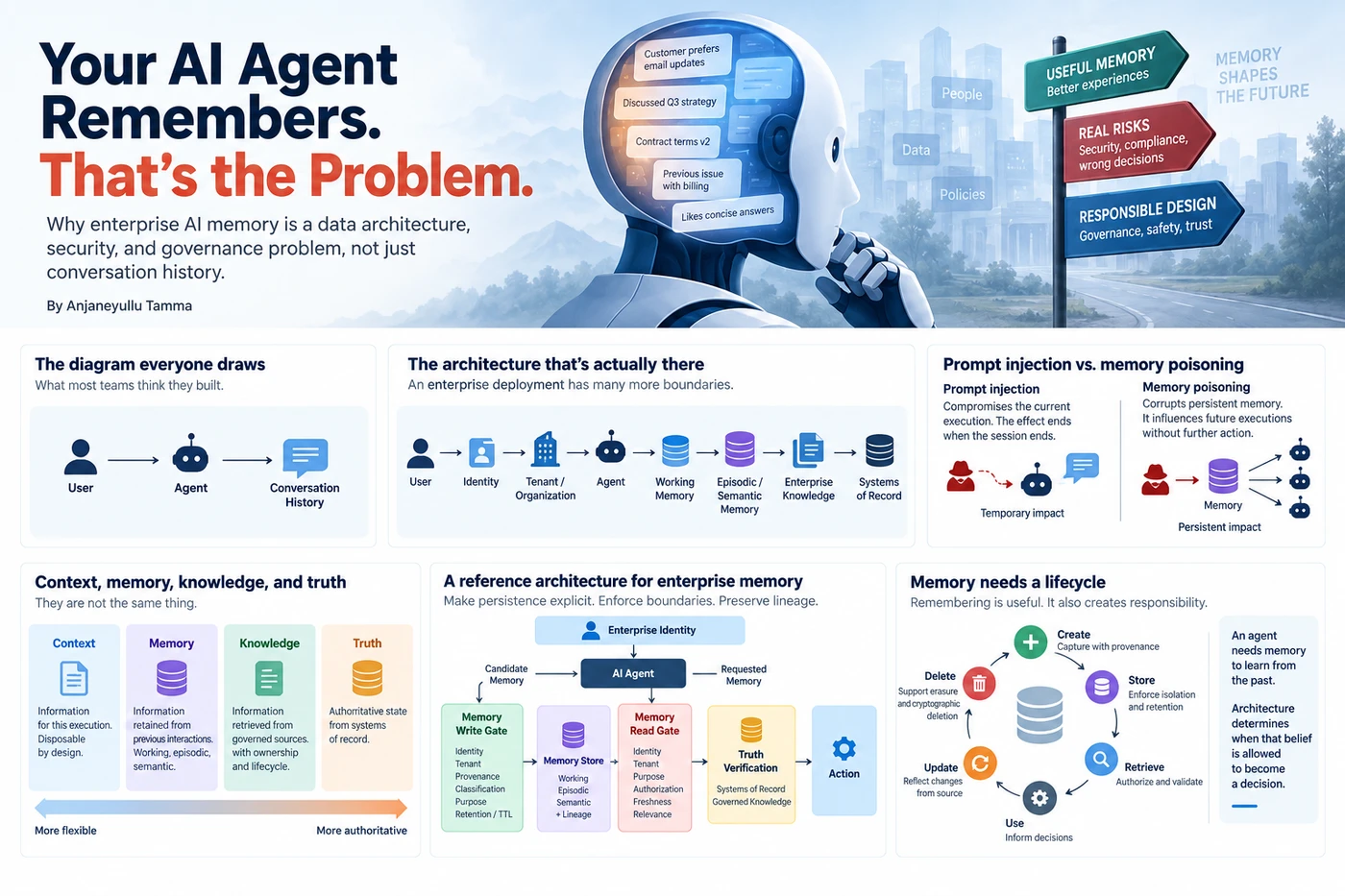
Why enterprise AI memory is a data architecture, security, and governance problem, not just conversation history.
Memory isn’t a conversational feature. It’s an unmapped, ungoverned data plane that happens to be wearing a chat interface.
That’s an uncomfortable claim for a capability everyone talks about in UX terms: the agent remembers your preferences; it feels like a colleague now.
That framing may be sufficient for a consumer chatbot. It falls apart the moment memory goes into production inside an enterprise.
Production means identity boundaries, tenant isolation, data ownership, retention obligations, access policies, lineage, deletion requirements, and an attack surface, whether or not anyone explicitly designed for them.
The moment an AI agent can carry information from one execution into another, memory stops being merely a model feature.
It becomes architecture.
The Diagram Everyone Draws, and the One That's Actually There
Consider the disconnect between how memory is usually envisioned and how it actually manifests in production.
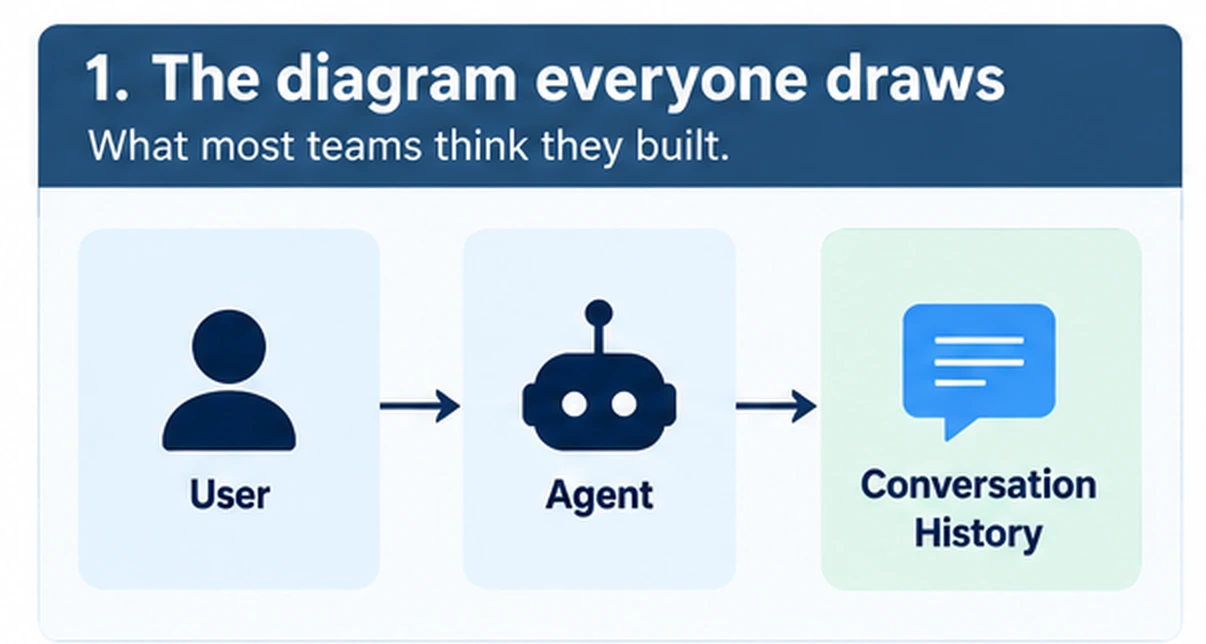
What most teams think they built:
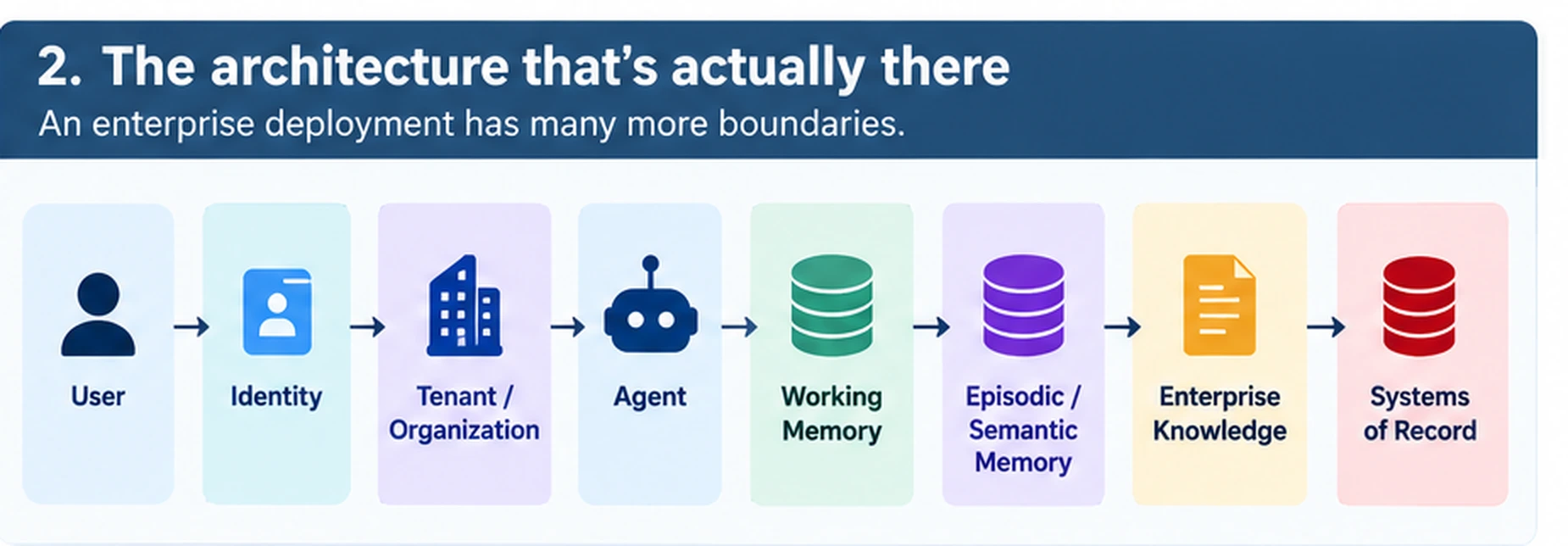
What an enterprise deployment increasingly looks like:
The first diagram works for a demo.
The second is closer to what a customer, security team, regulator, or auditor will eventually encounter.
Every boundary in that architecture is a place where information can change owner, authority, scope, provenance, or shelf life. Yet many agent platforms still make those transitions remarkably easy to leave implicit.
Once you draw the real picture, the hard questions organize themselves into three groups.
Identity and scoping. Who owns this memory? Can another agent retrieve it? Can another user see it? Could it ever cross an organization or tenant boundary?
Lineage and decay. Where did the remembered fact originate? Was it asserted by a user, retrieved from a governed source, inferred by a model, or copied from another memory? How long should it survive: the session, the case, the customer relationship, or indefinitely? What happens when the source changes?
Governance and compliance. What is the difference between something an agent remembers and something the enterprise knows? Can information retrieved for one authorized answer quietly become persistent context for future answers?
And eventually there is a more consequential question:
When does something the AI remembers become enterprise data?
When does it acquire an owner, classification, retention schedule, access policy, deletion obligation, and audit trail?
None of these are conversation-history questions.
They are data architecture questions that happen to arrive through a chat window.
Memory Poisoning Compromises the Future
A conventional prompt injection primarily compromises the current execution. Memory poisoning can compromise executions that haven’t happened yet.
An attacker may be able to introduce malicious or misleading information into persistent memory through an ordinary interaction, a document the agent processes, a website it reads, or another source the agent has been permitted to consume.
If that information becomes durable memory, the original interaction can disappear while its influence remains.
Days or weeks later, another execution retrieves the poisoned state and treats it as legitimate context.
This is one reason memory has become a distinct security concern in agentic systems. OWASP’s Agentic AI security work identifies Memory and Context Poisoning as a specific risk because corruption of persistent context can influence future reasoning and tool use.
The attack has effectively crossed a temporal boundary.
But an equally important failure requires no attacker at all.
Consider retrieval leakage.
An agent retrieves a document through RAG for a particular request. Access to that document is correctly authorized. The retrieval is tenant-scoped, identity-aware, and audited.
The agent then summarizes what it learned and, as an ordinary side effect of being helpful across sessions, persists the summary into episodic memory.
The next time the information is needed, the agent answers from memory instead of retrieving the original document.
The original authorization check is gone.
The source document’s access controls are gone.
Its retention policy may be gone.
Its deletion lifecycle may be gone.
Its provenance may be gone.
Nothing was attacked.
The agent simply moved information from a governed store into a differently governed one because the architecture never defined whether retrieval was allowed to become memory.
Both problems have the same root cause:
The memory layer accepts information without preserving enough information about where it came from, who was allowed to see it, and whether it was ever permitted to persist.
Memory Is a Cache of Belief, Not a Source of Truth
A memory is structurally similar to a cached belief about the world.
At some point in the past, an agent observed something, inferred something, retrieved something, or was told something, and retained a representation of it.
Like any cache, that representation can become stale.
A customer changes an address.
A supplier loses an approved status.
A contract is amended.
A user’s role changes.
A credit limit is reduced.
A policy is superseded.
The system of record changes, but the agent’s memory does not.
Now the enterprise has two versions of reality: the state the authoritative system currently holds and the state the agent remembers.
That becomes especially important when personal data is involved.
GDPR Article 17 establishes a right to erasure under applicable circumstances, and European regulators have continued examining how organizations implement that right in practice. For AI architectures, the engineering implication is broader than deleting a row from the application database.
Information may have propagated.
A source record may have produced an embedding in a vector store, a summary in episodic memory, a preference in a profile, or another derived representation elsewhere in the architecture.
Deleting the original does not automatically delete everything derived from it.
Without lineage, a request that appears to mean:
“Delete this person’s data.”
can quietly become:
“Delete this person’s data from the places we remembered to check.”
This is related to a principle from agent recovery architecture:
The checkpoint tells you what the agent believed happened. The system of record tells you what actually happened.
Memory extends that principle beyond recovery.
The architecture must preserve the distinction between what an agent remembers and what the enterprise currently considers authoritative.
Context, Memory, Knowledge, and Truth Are Not the Same Thing
Many of these problems trace back to a surprisingly simple modeling error.
Architectures frequently collapse context, memory, knowledge, and truth into one conceptual bucket because, from the model’s perspective, they eventually become the same thing:
tokens.
Architecturally, however, they carry very different obligations.
Context is information assembled for this execution. It may include the current request, temporary calculations, retrieved documents, tool results, or workflow state. It should generally be disposable by design unless something explicitly promotes it into a more durable tier.
Memory is information retained from previous interactions or executions. Working, episodic, and semantic memory can have different scopes and decay rates, but they share one important characteristic: they represent something the agent carries forward from its past.
Knowledge is information retrieved from governed sources: policy repositories, product catalogs, knowledge bases, controlled RAG corpora, enterprise documents, or other sources with ownership and lifecycle.
Truth is the authoritative state designated by the enterprise for a particular fact or transaction: the posted balance, approved contract, confirmed order, current entitlement, customer master record, or compliance status.
A system of record can itself contain incorrect data. “Truth” here does not mean philosophical certainty. It means the enterprise-designated authority for settling that particular question.
That distinction gives us an important architectural rule:
Memory can inform a decision. It should not silently become the system of record.
Memory may influence what an agent recommends, retrieves, prioritizes, or asks next.
But the moment memory is allowed to settle a consequential fact, such as a balance, entitlement, approval status, contract term, compliance state, or financial obligation, without checking the authority that owns that fact, the architecture has promoted belief into truth.
And nobody explicitly authorized the promotion.
Remembering Needs a Write Gate
If memory is enterprise data, persistence should not be an invisible side effect of generating a useful answer.
It should be an explicit architectural operation.
That is the purpose of a Memory Write Gate.
Before information becomes durable memory, the architecture should be capable of asking questions such as:
Where did this information come from?
        ↓
Who owns it?
        ↓
What tenant / organization does it belong to?
        ↓
What is its classification?
        ↓
Is persistence permitted for this purpose?
        ↓
How long may it survive?
        ↓
What lineage must follow it?
        ↓
Persist
This logic belongs in the orchestration and policy boundary, not merely inside a vector database.
A vector store can enforce namespaces, encryption, metadata filters, and retention mechanics. It cannot independently determine whether a model-generated inference should become a durable enterprise fact.
Persistence therefore becomes an explicit, logged operation rather than an accidental consequence of a conversation.
That helps close the retrieval-leakage path.
Information retrieved from a governed source doesn’t automatically earn the right to become memory merely because the model saw it.
Remembering Also Needs a Read Gate
Controlling what enters memory solves only half the problem.
Information can be perfectly legitimate to store and still be inappropriate to retrieve for a particular execution.
A customer’s preference may be valid long-term memory for a product recommendation.
It may be irrelevant, and potentially inappropriate, context for a credit decision.
An employee’s previous interaction may legitimately belong to one workflow but not another.
A memory created under one user’s authority may not be reusable when another user invokes the same agent.
This requires a second architectural boundary:
the Memory Read Gate.
Before remembered information enters an agent’s context, the architecture should evaluate:
Who is requesting it?
        ↓
For which tenant?
        ↓
For what purpose?
        ↓
Is retrieval authorized?
        ↓
Is the memory still valid?
        ↓
Is it sufficiently fresh?
        ↓
Is it relevant to this decision?
        ↓
Retrieve
The two gates serve different purposes.
The write gate determines what the agent may remember. The read gate determines when it is allowed to remember it.
Together, they turn memory from an ambient model capability into a governed enterprise service.
Memory Needs Lineage
Access control answers who can see the memory.
Retention answers how long it may exist.
Neither answers:
Where did this belief come from?
Every durable memory should retain enough provenance to trace it back to its origin.
A simple implementation might include a derivedFromId or equivalent lineage reference linking a memory entry to its source record, document, interaction, tool result, or upstream memory.
More sophisticated architectures may need a lineage graph because a single memory can be synthesized from multiple sources.
That enables questions that otherwise become surprisingly difficult:
- Which memories were derived from this customer record?
- Which agent decisions relied on this document?
- Which persistent memories were created from a source that has since been corrected?
- Which memories should be invalidated because their source was deleted?
- Which downstream representations inherited this data?
For some storage architectures, cryptographic erasure can provide an additional control. Appropriately scoped data can be encrypted under managed keys so that destroying those keys renders residual encrypted material inaccessible.
But cryptographic erasure solves only part of the problem.
It does not tell you where the information propagated, what was derived from it, or whether representations exist elsewhere.
That is what lineage provides.
Without lineage:
“We deleted it.”
is an assertion.
With lineage, it can become something the architecture can verify.
The Reference Architecture
The resulting architecture is not especially exotic.
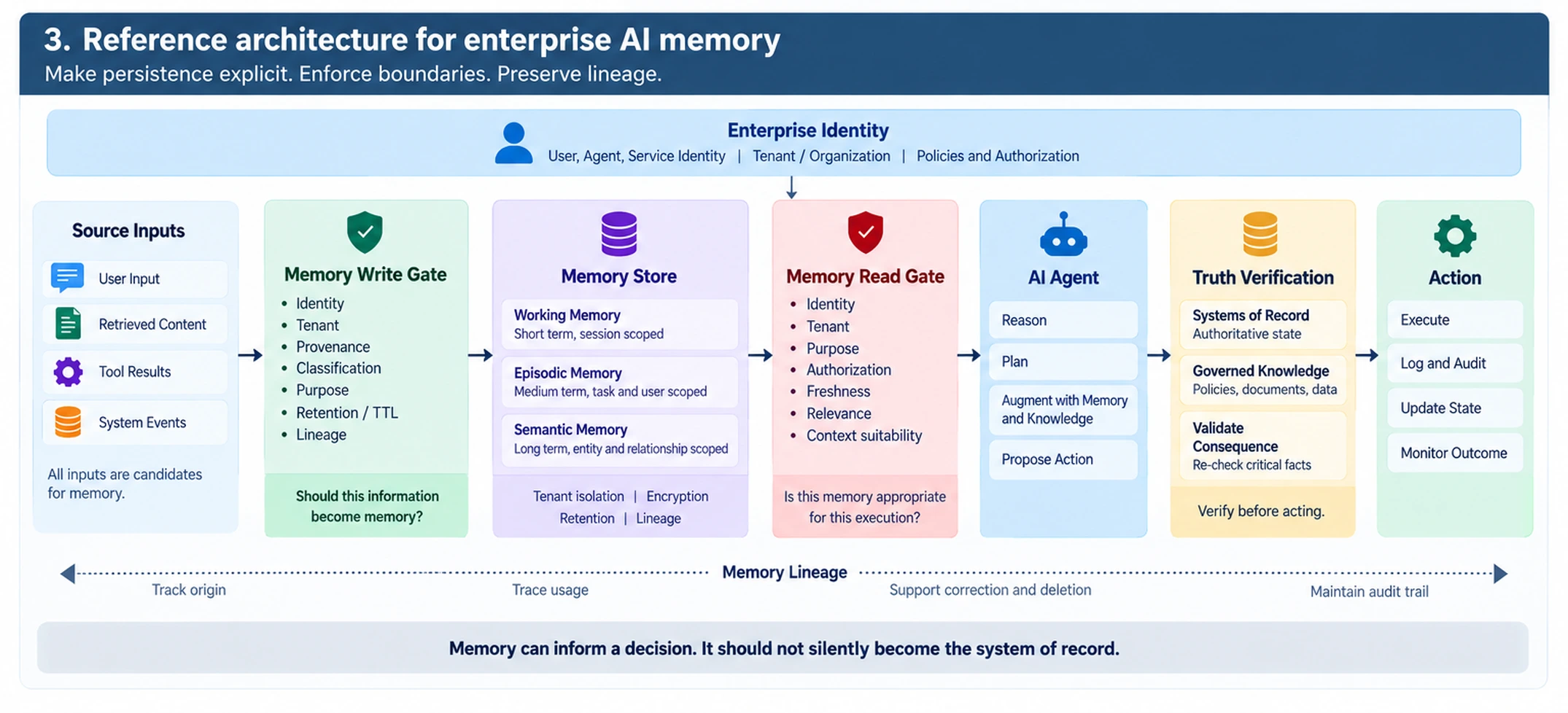
The orchestration layer decides what is worth remembering and makes persistence explicit.
The memory layer enforces isolation, lifecycle, provenance, and decay.
The read boundary determines whether stored memory is appropriate for the current identity, tenant, purpose, and decision.
The system-of-record boundary ensures that consequential facts are revalidated against their authoritative source before an action depends on them.
And lineage connects the entire lifecycle so that memory can be corrected, invalidated, traced, and deleted when its upstream sources change.
These are disciplines enterprises already apply to other forms of customer, employee, financial, operational, and regulated data.
What changes with AI is that the component producing and consuming the data can now retrieve information on its own initiative, summarize it, infer new information from it, persist those inferences, and later use them to influence another decision.
That makes implicit boundaries dangerous.
Memory Is Useful Precisely Because It Survives
None of this means enterprise agents should be stateless.
Quite the opposite.
Agents will need memory to become genuinely useful across long-running workflows, customer relationships, operational processes, investigations, and complex multi-step work.
An agent that forgets everything after every execution cannot build continuity.
But persistence creates responsibility.
The question isn’t whether enterprise agents should have memory.
The question is whether we treat that memory as convenient model context or as what it becomes the moment it survives an execution:
enterprise data with identity, provenance, ownership, retention, security, and lifecycle obligations.
An agent needs memory to learn from the past.
But the architecture must preserve a boundary between what the agent remembers, what the enterprise knows, and what the systems of record currently say is authoritative.
Because those are not the same thing.
Memory is a belief carried forward. Architecture determines when that belief is allowed to become a decision.