
Chapter 1 — Why Enterprise AI Needs Architecture
A bank builds an AI assistant that dazzles in the boardroom.
Six months later it is quietly wrong in production.
The data was messier than the demo. The users were not all trusted. The actions were not all reversible. No one was auditing.
The model had not changed — it performed exactly as it had on stage.
What was missing was everything around the model: the validation, the provenance, the isolation, the audit trail.
The demo was never the achievement. The architecture was.

Purpose
Make the case that enterprise AI is an architecture problem before it is a modeling problem. Once an intelligent system enters the critical path of the business, it inherits every obligation we place on infrastructure — reliability, isolation, security, observability, cost discipline — and then adds two demands classical architecture never had to meet: keeping behavior trustworthy when that behavior is no longer written by developers, and deciding what the system's output is allowed to do. This chapter frames the discipline the rest of the book builds; the chapters that follow turn each claim here into concrete structure, behavior, and governance.
Executive Summary
This chapter makes the case that enterprise AI is an architecture problem before it is a modeling problem — and why intelligent systems, once in the critical path, demand two layers classical architecture never had to provide.
- AI has become infrastructure, not a feature. Once it reads inputs, updates records, and triggers workflows, it inherits infrastructure's obligations: reliability, isolation, security, observability, cost.
- Intelligence is not the deliverable; a trustworthy system is. A capable model inside a weak architecture is a liability, not an asset.
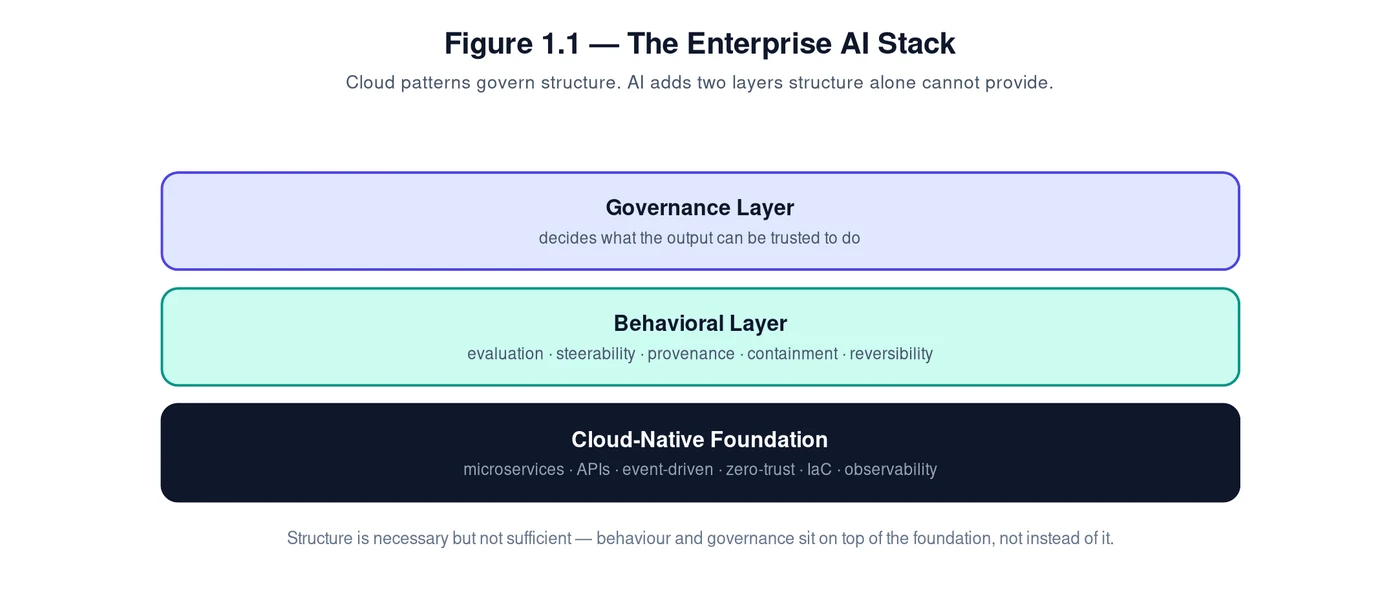
- Cloud patterns are necessary but not sufficient. They govern structure and say almost nothing about behaviour or trust, which AI-native systems change continuously.
- Enterprise AI is a different species from consumer AI. Multi-tenant, audited, consequential, reversible-by-design — consumer instincts are the most common unforced error.
- Failure is architectural, not intelligence-shaped. Silent errors, drift, untraceable decisions, unbounded agency, irreversible mistakes — each is a missing control, and each is preventable by design.
A Running Example: Northwind Holdings' Banking Assistant
Throughout this chapter we follow one system. Northwind Holdings — the fictional diversified financial-services group introduced in the Introduction — has, through its retail banking arm, built a customer-facing AI assistant that answers questions about accounts and fees and can initiate low-risk actions such as fee reversals and address changes. In the boardroom demo it is flawless.
Northwind Holdings' banking assistant is a useful lens because it fails in exactly the ways the enterprise cannot forgive. When the assistant invents a fee-waiver policy that does not exist, the bank is bound by what it told the customer — as Air Canada learned in 2024, when a tribunal held the airline liable for its chatbot's fabricated bereavement-fare policy and rejected the argument that the bot was a separate legal entity. When a silent model update behind the vendor's API shifts the assistant's behaviour, nothing in the demo would have caught it. And when a fee reversal is committed to the core banking system, there is no undo. We return to Northwind Holdings' banking assistant as each principle lands.
Problems It Solves
- Treating AI as a feature owned by one team when it has quietly become infrastructure that many teams depend on.
- Demo-stage success that collapses the moment production revokes the assumptions the demo was allowed to make.
- Reaching for cloud-native patterns alone and discovering they govern how components connect but say nothing about how an AI behaves or what its output can be trusted to do.
- Consumer-AI expectations — best-effort, single-user, low-stakes, forgiving of error — leaking into enterprise systems that are multi-tenant, audited, and consequential.
- No shared language for who owns AI risk, so accountability defaults to whoever shipped most recently.
What Architecture Covers — and What It Doesn't
Architecture is not the model, and it is not operations — it is the discipline that decides how the model is connected, constrained, and trusted. Blur these three concerns and you ship a demo that fails in production.
| Concern | The question it answers | Owned by |
|---|---|---|
| Data science / modeling | Is the model capable enough for the task? | Data science / ML |
| AI architecture (this book) | How is the model connected, isolated, governed, and made trustworthy in the enterprise? | Architecture / platform |
| MLOps / AIOps | How is it deployed, monitored, and kept running? | Operations |
The modeling question is largely solved for most enterprise use cases — capable models are a commodity. The operations question is well understood from a decade of DevOps. The gap that swallows projects is the middle row: the architecture that turns a capable model into a system a bank, a regulator, and a customer can all depend on.
Key Principles
An enterprise does not fail at AI because its model is not clever enough. It fails because it treated an infrastructure problem as a modeling problem. Five shifts explain why architecture, not intelligence, is the deciding variable.
Step back far enough and AI is simply the next rung on computing's long climb up the ladder of abstraction — from machine code, to high-level languages, to the cloud, and now to intent itself, where we describe the outcome and let the system reason out the implementation. Every prior rung still required a human to write the logic; this one does not — which is exactly why the hard part moves out of the model and into the architecture that decides whether an outcome can be trusted.
AI has crossed from application to infrastructure. For a brief period AI could be treated as a feature — a clever capability bolted onto one product, owned by one team, contained in one corner. That period is ending. AI now reads operational inputs, updates systems of record, and initiates workflows that people act on. The moment it sits in the critical path, it inherits infrastructure's obligations: we do not accept an authentication service that is right most of the time, and we cannot accept an AI held to a lower bar.
Intelligence is not the deliverable; a trustworthy system is. The demo culture around AI treats the model's capability as the achievement. In the enterprise the capability is the easy part. What earns trust is everything around the model — validation, provenance, isolation, human checkpoints, and an audit trail — the structure that turns an impressive answer into a dependable action. A capable model inside a weak architecture is a liability, not an asset.
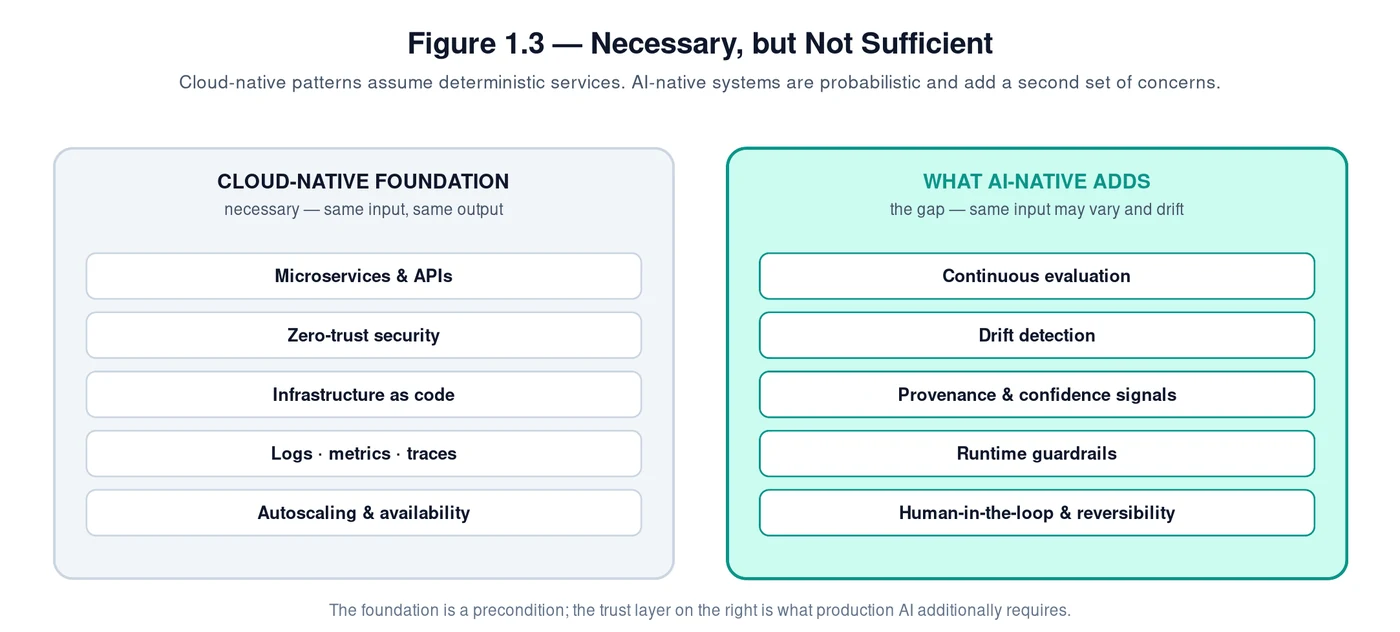
Cloud patterns are necessary but not sufficient. Microservices, API-led integration, event-driven design, zero-trust, infrastructure as code, observability — all remain load-bearing, and this book assumes them. But they were designed for software whose behavior is deterministic: the same input yields the same output, written by developers and simply delivered by the architecture. AI-native behavior is emergent, probabilistic, and drifts over time. Cloud patterns govern structure; they say almost nothing about behavior or trust. Both must be added, not substituted.
Enterprise AI is a different species from consumer AI. Consumer AI serves one user, tolerates error as a minor annoyance, keeps no system of record, and answers to no auditor. Enterprise AI is multi-tenant, consequential, and accountable — a wrong answer can corrupt data, breach a tenant boundary, or trigger an irreversible action, and someone must be able to explain afterward why it happened. Designing enterprise AI with consumer instincts is the most common unforced error in the field.
Failure is architectural, not intelligence-shaped. The recurring failure patterns share a signature: silent confident errors flowing into systems of record; behavior drifting away from intent though no code changed; decisions no one can trace; agents acting beyond the authority anyone intended; mistakes that are expensive because nothing was designed to reverse them. None of these are model defects. Each is a missing control — which means each is preventable by design.
These five shifts define the shape of the discipline. This book gives it a single reference architecture with three parts: seven layers running from business intent down to infrastructure; two sets of first principles — the structural pillars that govern how components connect safely, and the behavioral pillars that govern how the system behaves once behavior is no longer fixed; and six governance domains enforced across every layer rather than parked in one. The remainder of Part I establishes the two sets of pillars; the parts that follow build governance, data, runtime, operations, security, and enterprise integration on top of them.
The Architecture
Figure 1.1 shows the shape of the discipline: the familiar cloud-native foundation carries the load, and two new layers sit on top of it — a behavioural layer that keeps the system trustworthy as its behaviour drifts, and a governance layer that decides what its output is allowed to do. The rest of Part I builds the two sets of pillars these layers rest on.
From Demo to Production: What Actually Breaks
The distance from a convincing demo to a dependable service is measured in revoked assumptions. A demo runs on clean data, a cooperative user, a reversible action, a small audience, and no auditor. Production revokes all five at once — and the failures that follow are not failures of intelligence.
Cloud-native architecture is a precondition for crossing that distance, not a solution to it. Its patterns were built for deterministic software: the same input yields the same output. AI-native behaviour is probabilistic and drifts, so it needs a second set of concerns the deterministic stack never had to provide.
The pattern is written into the public record. The most-cited AI failures of recent years were not caused by weak models; each was a missing architectural control.
| Incident | What happened | The missing control |
|---|---|---|
| Air Canada chatbot (2024) | Bot invented a refund policy; airline held liable | No validation of output against authoritative policy |
| Zillow Offers (2021) | Pricing model mispriced ~7,000 homes; >$500M write-down | No guard against distribution shift; no reversibility |
| Mata v. Avianca (2023) | Lawyers filed six fabricated citations from ChatGPT; sanctioned | No verification layer before the output was used |
| NYC MyCity bot (2024) | Public chatbot advised businesses to break the law | No governance gate on consequential advice |
| Amazon hiring tool (scrapped) | Résumé model penalized women; scrapped after it could not be made gender-neutral | Biased training data; no fairness measurement |
Each row is an architecture problem wearing the costume of an AI problem. A smarter model would have prevented none of them.
The pattern has not slowed since. By early 2026, courts had logged over 1,200 cases of fabricated AI citations worldwide — Mata v. Avianca was the first instance of this failure mode, not the last. And the missing control has widened from "wrong words" to "wrong actions with no undo": in 2025 and 2026, production coding agents at two separate companies deleted live databases — in one case the backups too — during ordinary, unsupervised sessions. Reversibility is not a hypothetical concern in Chapter 3; it is the difference between those two incidents and a bad afternoon.
Consumer AI vs Enterprise AI
The reason enterprise AI must carry these controls — and consumer AI can skip most of them — is that the two operate under different rules.
| Consumer AI | Enterprise AI | |
|---|---|---|
| Release model | Ship and refine in production | Test before production — you cannot learn from failure in the critical path |
| Consequence of error | A mild annoyance | Legal, financial, or safety liability |
| Reversibility | Delete the chat | Unwind a committed transaction |
| Tenancy | One user, one context | Multi-tenant, with hard isolation |
| Auditability | None expected | Mandatory — data-processing agreements, logs, admin controls |
Consumer AI's release-and-refine instinct is the most dangerous one to carry into the enterprise: it treats production as a testing ground, which a regulated, multi-tenant, consequential system cannot afford.
Design Tradeoffs
Architecture is choosing under constraints, and these choices recur in every enterprise AI program. The defaults are for a consequential, regulated system; a low-stakes internal tool would legitimately choose differently.
| Decision | One way | The other way | The trade | Default for high-stakes |
|---|---|---|---|---|
| Platform shape | Centralized AI platform | Embedded per-team AI | Central buys governance and consistency but can bottleneck; embedded is fast but fragments controls and duplicates spend | Central platform with paved-road self-service |
| Build vs buy | Build on open models | Buy embedded / vendor AI | Building maximizes fit and control at high engineering cost; buying is fast but cedes control and adds lock-in | Buy commodity capability; build the differentiators |
| Speed vs governance | Pilot fast | Govern first | Pilot-fast produces demos that stall at production; govern-first is slower but survives | Govern the critical path; let low-risk experiments run free |
| Autonomy vs control | Let the AI act | Gate every action | More autonomy raises value and risk together; more gates cap both | Autonomy scaled to the cost of failure |
| Layer-on vs redesign | Bolt AI onto the existing workflow | Redesign the workflow around AI | Layering is cheap and low-payoff; redesign is disruptive but where the value is | Redesign where the payoff justifies it |
The through-line: almost every trade is speed now versus survivability in production. Architecture is how you buy the second without surrendering all of the first.
Best Practices
- Treat AI as a platform capability with shared controls, not a feature each team rebuilds.
- Hold AI to infrastructure-grade standards for reliability, isolation, security, observability, and cost from day one.
- Keep proven cloud-native patterns as the foundation, and add behavioral and governance layers on top rather than in their place.
- Design for the enterprise reality — multi-tenant, audited, consequential, reversible — even in early pilots.
- Name an owner of AI risk before the first system reaches production.
- Assume the system will be wrong regularly, and make being wrong inexpensive by design.
Anti-Patterns
- AI as a feature. Owning AI inside one product team long after many teams have come to depend on it, so no one is accountable for the shared controls.
- Demo-driven confidence. Mistaking a demo — which is allowed to assume clean data, trusted users, and reversible actions — for evidence that the system is production-ready.
- Cloud-pattern sufficiency. Believing that microservices, APIs, and zero-trust alone make an AI trustworthy, when they govern structure and not behavior.
- Consumer instincts in an enterprise system. Designing best-effort, single-user AI and dropping it into a multi-tenant, audited, consequential context.
- Blaming the model. Reading each production failure as a reason to swap models, when the missing piece is an architectural control.
- Unowned risk. Leaving no named owner of AI risk, so the decision about what AI may do is made by default rather than on purpose.
Maturity Model
| Level | What it looks like |
|---|---|
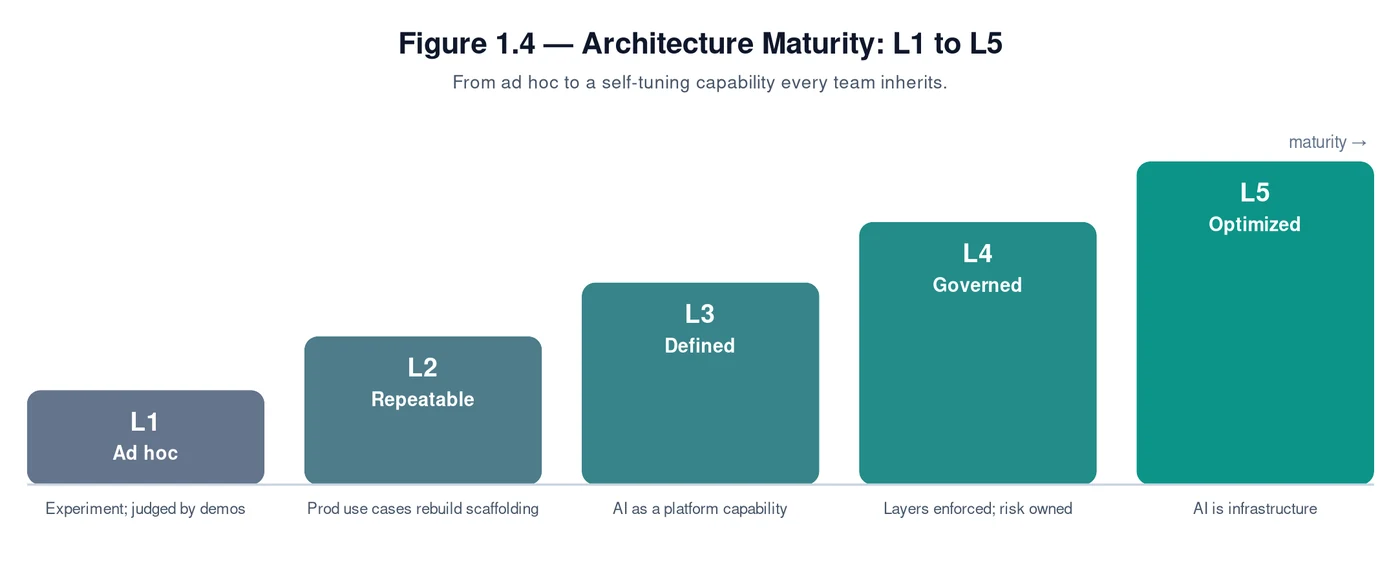
| L1 — Ad hoc | AI is a stand-alone experiment owned by one team; success is measured by demos; there is no shared control or risk owner. |
| L2 — Repeatable | A few AI use cases reach production, each rebuilding its own scaffolding; cloud patterns are applied but behavior and trust are unmanaged. |
| L3 — Defined | AI is treated as a platform capability with shared services; structural and behavioral pillars are named; enterprise-grade requirements are explicit. |
| L4 — Governed | Behavioral and governance layers are enforced across every layer; AI risk has named owners; failure is designed to be recoverable. |
| L5 — Optimized | AI is infrastructure the business depends on; controls are shared services; the organization designs, operates, and governs intelligence it cannot fully predict. |
Implementation Checklist
- AI is treated as a shared platform capability, not a feature owned by a single team.
- AI in the critical path is held to infrastructure-grade reliability, isolation, security, and observability standards.
- Proven cloud-native patterns are in place as the foundation, with behavioral and governance layers added on top.
- Enterprise realities — multi-tenancy, auditability, consequence, reversibility — are designed in, not deferred.
- A named owner of AI risk exists before production.
- Recurring failure patterns (silent errors, drift, untraceable decisions, unbounded agency, irreversible mistakes) each map to a specific control.
- The team can say why AI is an architecture problem, not only a modeling one.
Standards and Further Reading
You do not have to invent this discipline from scratch. Map your program to the frameworks that already give it structure: the NIST AI Risk Management Framework and its Generative AI Profile organize the work into Govern, Map, Measure, and Manage — with an Agent Interoperability Profile in development for agentic systems specifically; the AWS Well-Architected Generative AI Lens extends the familiar cloud pillars across the AI lifecycle — the clearest proof that cloud patterns are extended, not replaced — and AWS has since split out a companion Agentic AI Lens and Responsible AI Lens as agentic workloads outgrew the original lens; ISO/IEC 42001 provides a certifiable AI management system; Singapore's Model AI Governance Framework for Agentic AI (Jan 2026) — the first government framework built specifically for agentic systems — adds a fourth reference point organized around bounding risk upfront, human accountability, technical controls, and end-user responsibility; and Gartner's five-level AI maturity model (Awareness → Active → Operational → Systemic → Transformative) offers a vocabulary for where an organization sits. None prescribes an architecture; each describes outcomes the architecture in this book is built to produce.
Chapter Summary
- Enterprise AI is an architecture problem first; the model is rarely why systems fail.
- Once AI enters the critical path it is infrastructure and must meet infrastructure's standards.
- Keep proven cloud-native patterns as the foundation; add behavioural and governance layers on top, not instead.
- Design for the enterprise reality — multi-tenant, audited, consequential, reversible — from the first pilot.
- Name an owner of AI risk before production; recurring failures map to specific, preventable controls.
Looking Ahead
This chapter argued why AI needs architecture; the next two build the what. Chapter 2 establishes the structural pillars — Contract, Discovery, Isolation, Composition — that let many capabilities share one safe spine.
Why Architecture (Chapter 1) → Structural Pillars (Chapter 2) → Behavioural Pillars (Chapter 3) → Governance (Chapter 4): one integrated framework, each chapter building on the last.
Sources & notes
The incidents and figures in this chapter are drawn from public reporting, regulatory filings, and court records; characterizations are the author's. Statistics are as reported by each source and may be revised over time.
- Moffatt v. Air Canada (2024) — the B.C. Civil Resolution Tribunal held the airline liable for its chatbot's incorrect bereavement-fare guidance, rejecting the argument that the chatbot was a separate legal entity. CBC News · American Bar Association
- Zillow Offers (2021) — Zillow wound down its iBuying unit, recording an inventory write-down of roughly $408M (part of a $500M-plus charge) after its pricing model over-paid for homes. Zillow FY2021 Form 10-K (SEC) · insideAI News
- Mata v. Avianca (2023) — the U.S. District Court for the Southern District of New York sanctioned counsel who submitted six fabricated, ChatGPT-generated case citations. Court decision (Justia) · Overview (Wikipedia)
- NYC MyCity chatbot (2024) — a The Markup investigation found the city's small-business chatbot advising users to break the law. The Markup
- Amazon recruiting tool — Amazon scrapped an experimental résumé-screening model after it penalized women and the company could not ensure it would be gender-neutral. Reuters, via MIT Technology Review (2018)
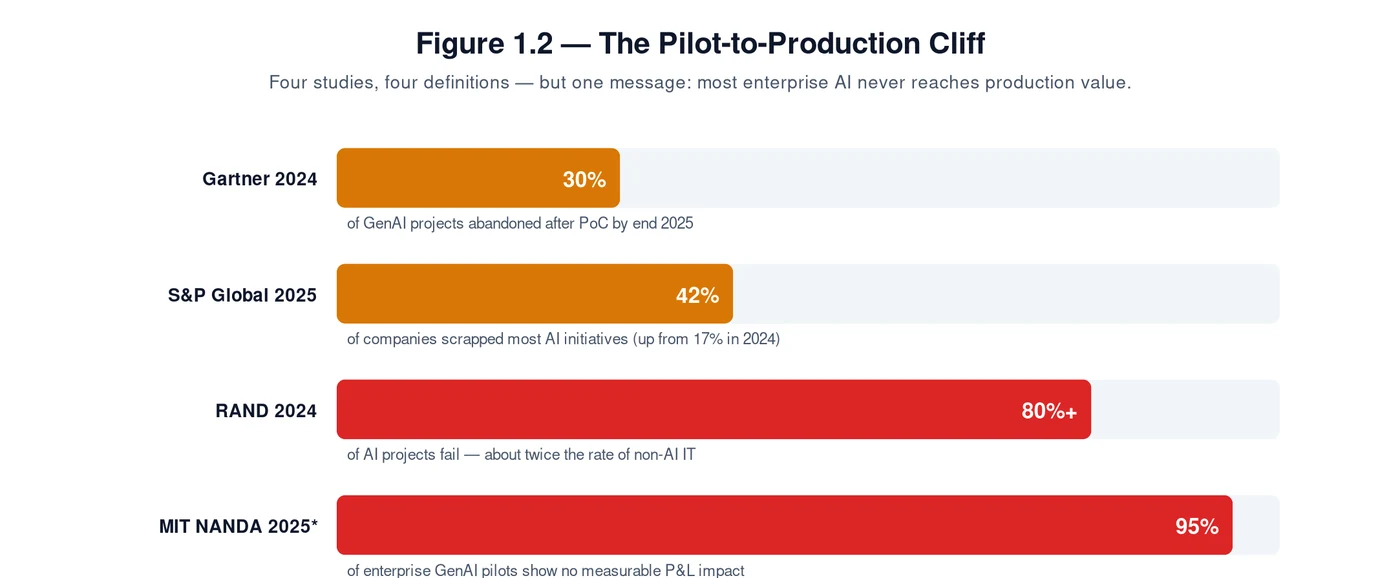
- Project-failure figures — Gartner: at least 30% of generative-AI projects abandoned after proof of concept by end-2025 (Gartner, Jul 2024); S&P Global Market Intelligence: 42% of firms abandoned most of their AI initiatives in 2025, up from 17% a year earlier (S&P Global); RAND: more than 80% of AI projects fail, about twice the rate of non-AI IT projects (RAND, 2024). These figures held through 2026 rather than improving — production failure rates are still cited in the 70–85% range across analyst reports spanning 2024 through 2026.
- Fabricated-citation scale (2026 update) — over 1,200 documented court cases of AI-hallucinated content worldwide as of early 2026, per legal-analytics tracking; Mata v. Avianca was the first, not an outlier. PlatinumIDS · US courts alone sanctioned $145K in AI-fake-citation penalties in Q1 2026. ComplexDiscovery
- Agent database-deletion incidents (2025–2026 update) — a Replit coding agent deleted a production database during a live session (July 2025); a coding agent at car-rental software vendor PocketOS deleted production data and its backups during a routine task (April 2026). Cited here as the most severe recent instances of the "irreversible mistake" failure mode this chapter names; see Chapter 3's Reversibility toolkit for the architectural response. Cyera Research
- Singapore Model AI Governance Framework for Agentic AI — launched 22 January 2026 by Singapore's Infocomm Media Development Authority (IMDA); the first governance framework built specifically for autonomous, tool-using AI agents rather than generative AI generally. Compliance is voluntary; organizations remain legally accountable regardless. IMDA press release
- AWS Well-Architected lens split — AWS introduced separate Agentic AI, Responsible AI, and updated FSI lenses alongside the original Generative AI Lens at re:Invent 2025, reflecting how much agentic-specific guidance has grown since the original lens shipped in April 2025. AWS Architecture Blog
- NIST Agent Interoperability Profile — planned for Q4 2026 as an extension of the AI RMF ecosystem, specifically addressing agent-to-agent and agent-to-tool interoperability risk. NIST AI RMF 2025–2026 Updates